
AI-Enabled Evaluation of Treatment Response in Recurrent Brain Tumors Using MRI
NIH
Motivation & Problem Description
- More than 90% of patients with glioblastoma—one of the most aggressive types of primary brain cancer—experience recurrence, often within months of initial treatment.
- Distinguishing recurrent tumor from treatment-induced changes in the patient’s brain is essential for evaluating treatment response and planning subsequent therapy.
- Biopsy can provide this distinction, but it is invasive and samples only a small portion of the lesion, while the two conditions can look very similar on MRI.
Objective
- Use MRI and advanced AI to map recurrent tumor and treatment-induced changes throughout each patient’s brain.
- Support individualized, accurate treatment evaluation and clinical decision-making.
Solution
- Developed BioNet, a novel AI model integrating MRI and cancer biology, producing patient-specific, voxel-resolution prediction maps of recurrent tumor and treatment-induced reactive or inflammatory tissue.
Impact
- Demonstrated robust performance across patient cohorts with different imaging conditions.
- Could improve assessment of whether treatment is working.
- Could enable noninvasive monitoring and more timely treatment adjustments.
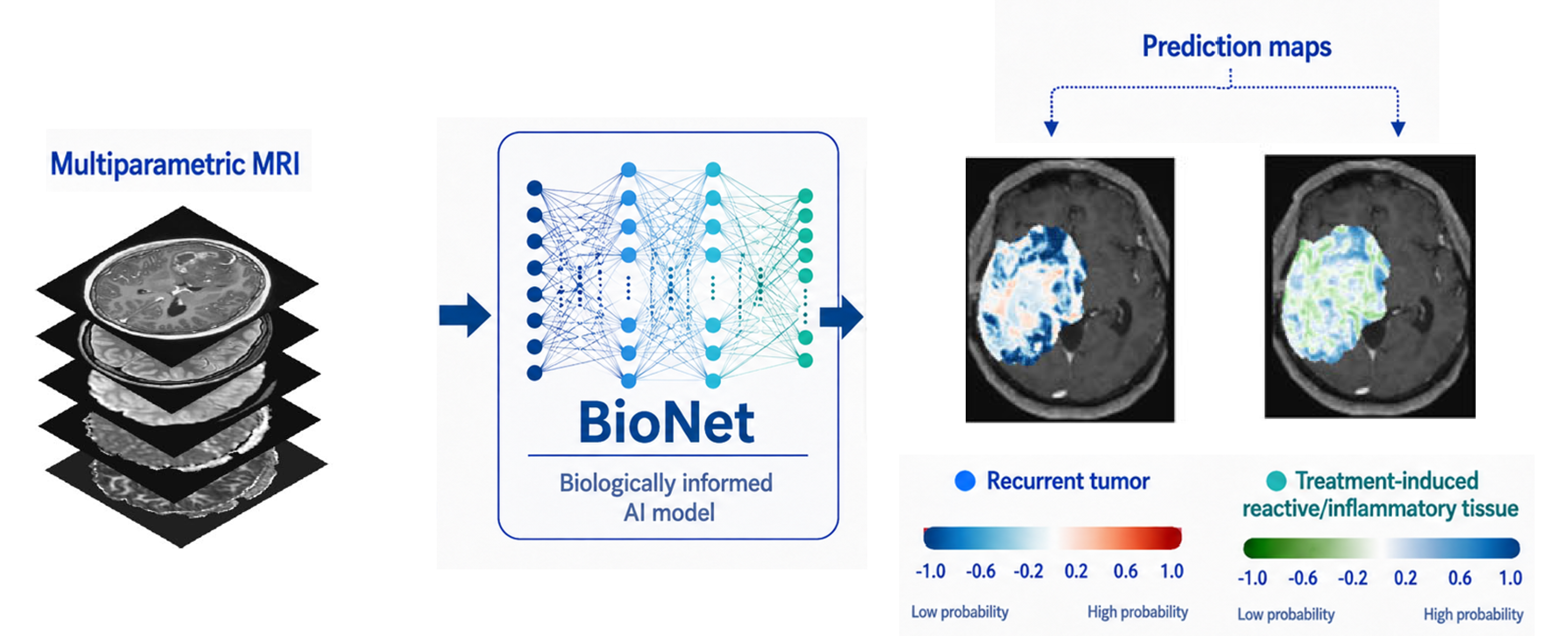
click image to enlarge
ISyE Faculty PI

Jing Li
Associate Chair for Faculty Development and Research
Virginia C. and Joseph C. Mello Chair
Professor