
Gateway Choice: A Total Cost and Reliability Decision
Georgia Ports Authority
Motivation & Problem Description
- Global supply chains face growing uncertainty from port congestion, capacity constraints, disruptions, and inland transportation variability.
- Gateway decisions often focus on ocean rates and average transit times, overlooking costs and uncertainty from port dwell, transloading, rail, and inland transportation.
- Understanding end-to-end total cost and reliability is therefore critical for shippers seeking more cost-effective and resilient gateway strategies.
Objective
- Develop a data-driven, end-to-end framework to evaluate gateway choices based on total transportation cost, transit time, and reliability.
- Identify key sources of cost and variability across ocean, port, and inland transportation.
- Support shippers in making more informed gateway and routing decisions.
Solution
- Integrated AIS vessel tracking, port and container-level operational data, transportation cost information, and industry input to characterize real-world route performance.
- Modeled time and cost uncertainty using statistical distributions and Monte Carlo simulation to compare gateway alternatives beyond simple averages.
Impact
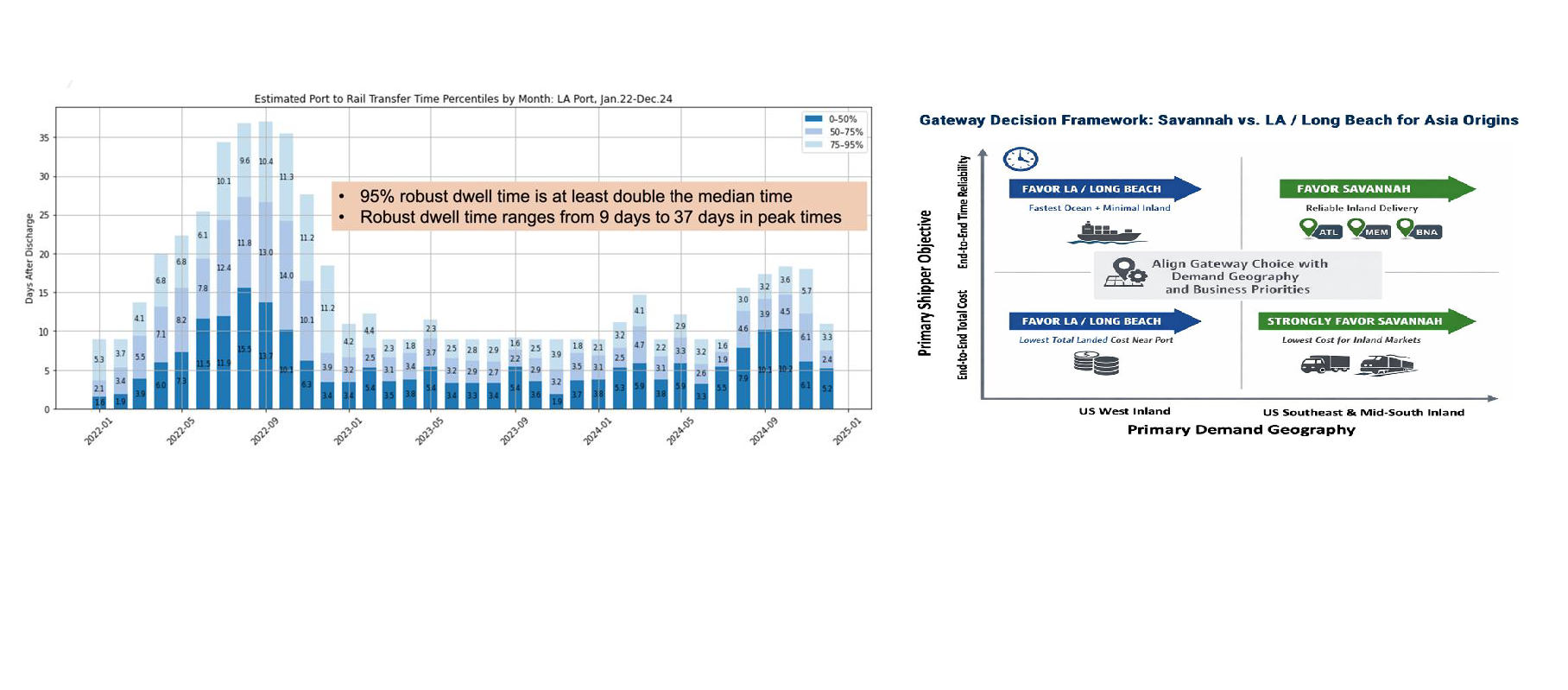
- For Asian imports destined for inland U.S. markets, routing through LA/Long Beach is traditionally attractive because of its shorter ocean transit time and lower ocean freight cost compared with Savannah.
- However, for Atlanta, Memphis, and Nashville, the analysis shows that Savannah’s shorter and less costly inland movement can more than offset its longer and more expensive ocean leg, resulting in approximately $1,000 lower total landed cost per FEU than routing through LA/Long Beach across modeled scenarios.
click image to enlarge
ISyE Faculty PI

Benoit Montreuil
Coca-Cola Material Handling & Distribution Chair
Professor
Director of the Physical Internet Center and Executive Director of the Supply Chain & Logistics Institute