
Generative AI for Power Outage Forecasting and Grid Resilience
Argonne National Laboratory, U.S. Department of Energy
Motivation & Problem Description
- Extreme weather can cause severe, spatially correlated, and long-lasting power outages, with major economic and societal consequences.
- Severe events are rare within any single region, leaving regional forecasting models with limited examples of disruption, escalation, and restoration.
- Existing methods often produce only point forecasts and may not capture spatial propagation, complete event trajectories, or forecast uncertainty.
- High-resolution customer outage reports and weather records provide an underused data source for understanding grid resilience and improving preparedness.
Objective
- Develop a national-scale, data-driven framework for understanding, forecasting, and simulating power outages under extreme weather.
- Predict outage onset, escalation, peak impact, and restoration across geographic regions.
- Quantify forecast uncertainty and generate plausible scenarios for rare, high-impact events.
- Support utility preparedness, emergency response, restoration planning, and grid-resilience investment.
Solution
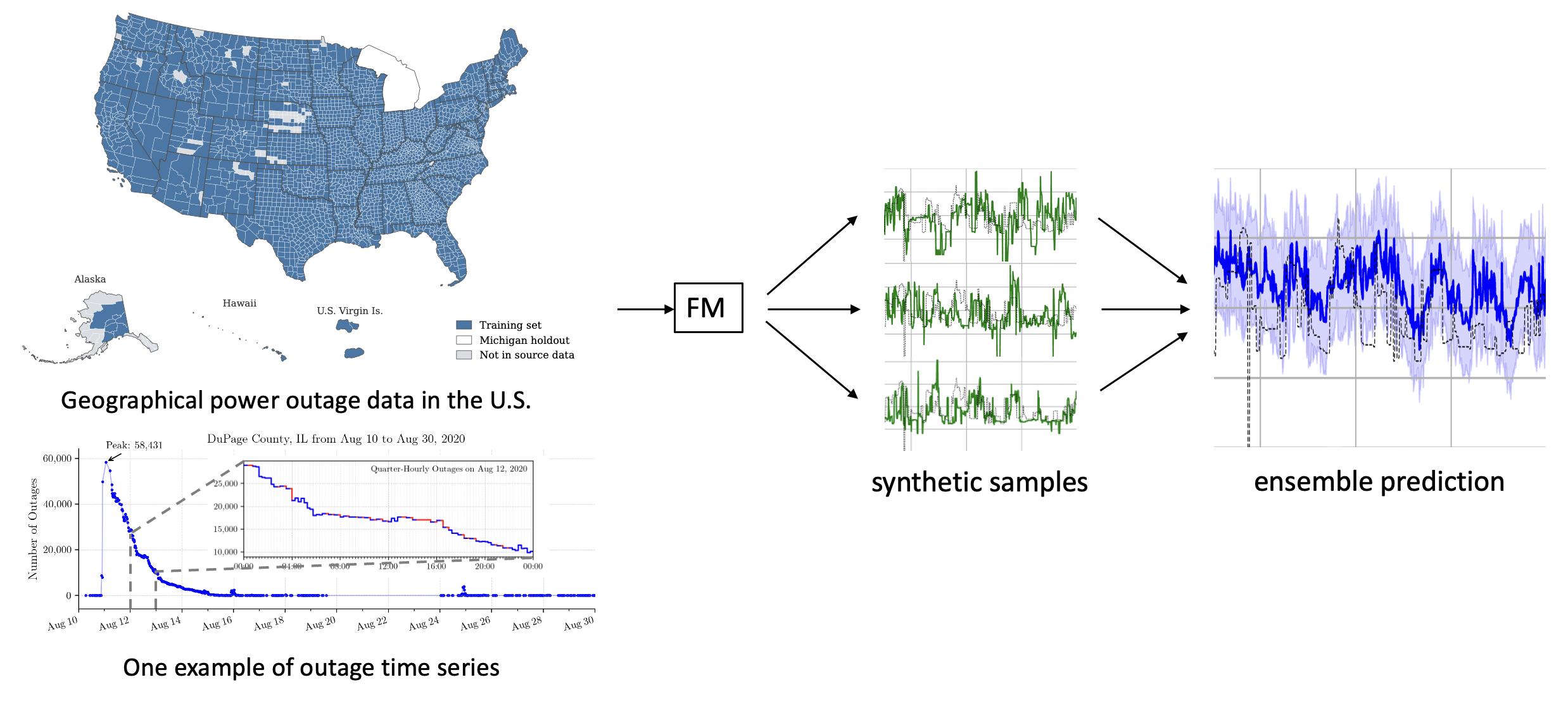
- Large-scale outage data: Combined 15-minute customer outage records with high-resolution weather data, expanding from detailed multi-state storm studies to a nationwide archive covering 2,977 counties and county equivalents.
- Spatio-temporal resilience modeling: Developed graph-based statistical models that capture cumulative weather effects, outage propagation among geographic areas, and restoration over time. The models quantify regional vulnerability, criticality, and recoverability.
- Generative foundation model: Developed OutageDiT, a domain-specific foundation model that uses 14 days of historical outage, weather, and calendar data to generate the next seven days of county-level outages at 15-minute resolution. It provides point- and probabilistic predictions, as well as complete outage scenarios, within a single model.
- Uncertainty quantification: Developed Graph Conformal Prediction, which uses recent forecast errors and information from neighboring regions to construct adaptive prediction regions for spatially and temporally dependent outage data.
Impact
- Model-based resilience simulations found that targeted interventions at a small number of critical or vulnerable locations could reduce customer outages by approximately 45% to 50% in the studied cases.
- Graph Conformal Prediction attained near-target overall coverage across studies of major storms in Massachusetts, Georgia, North Carolina, and South Carolina, while providing more consistent prediction regions than methods using temporal information alone.
- On a national benchmark containing both routine and high-impact periods, OutageDiT reduced mean squared prediction error by 14.6% and weighted quantile loss by 6.9% relative to fine-tuned Chronos-2, the strongest supervised comparator.
- The resulting framework can help utilities and public agencies anticipate outage severity, evaluate uncertainty, prepare restoration resources, generate stress-testing scenarios, and assess investments in grid resilience.
click image to enlarge
ISyE Faculty PI

Yao Xie
Coca-Cola Foundation Chair
Professor