
Identifying Gaps in Access to Risk-Appropriate Maternal Care
Georgia Clinical & Translational Science Alliance
Motivation & Problem Description
- The United States has extremely poor maternal outcomes for a high-income country, and many of these poor outcomes are preventable
- >40% of high-risk pregnant people do not deliver in facilities with "risk-appropriate" equipment/specialists. When this happens, the chances of poor maternal outcomes is significantly higher
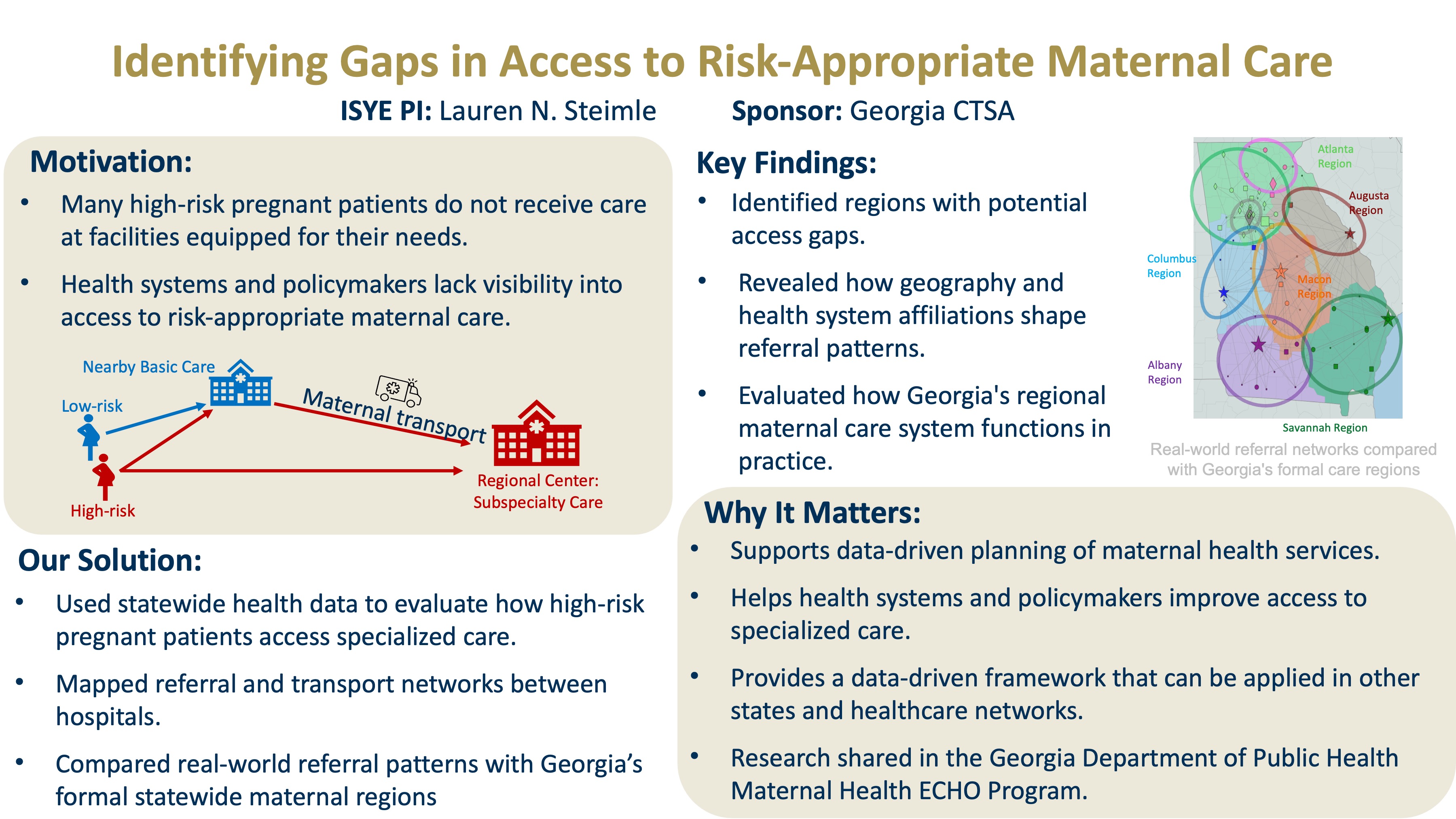
- Maternal transport is a key part of a systems-level strategy to coordinate care among facilities to transport pregnant people from facilities without "risk-appropriate care" to a facility that has the right care for them.
- Health systems and policymakers have limited visibility into whether high-risk pregnant patients are reaching facilities equipped to provide risk-appropriate care. Without this information, it is difficult to identify gaps in maternal care access and target investments effectively
Objective
- Quantify how maternal transports are being used across a statewide healthcare system.
- Identify geographic regions and hospital networks where access to risk-appropriate maternal care may be limited.
- Evaluate whether maternal transport patterns align with regional care coordination policies.
Solution
- Analyzed over 700,000 Georgia birth records spanning five years.
- Developed network analytics methods to characterize referral and maternal transport patterns across hospitals.
- Identified naturally occurring care coordination networks and compared them with planned regionalization structures.
Impact
- Identified regions with elevated maternal transport rates that may indicate a lack of access to risk-appropriate maternal care.
- Demonstrated how health system affiliations and geographic distance influence maternal transport decisions.
- Generated evidence used by policymakers, public health agencies, and maternal health stakeholders to evaluate regionalized systems of care.
- Featured in statewide media and public health forums, including the Atlanta Journal-Constitution and Georgia DPH Maternal Health ECHO series.
click image to enlarge
ISyE Faculty PI

Lauren Steimle
Harold R. and Mary Anne Nash Early Career Professor
Assistant Professor