
Long Tail Fast Delivery
Amazon.com
Motivation & Problem Description
- E-commerce retailers invest billions of dollars annually in fulfillment infrastructure to meet accelerating customer delivery expectations. Customers increasingly expect fast delivery, and unmet delivery time expectations directly translate into lost sales. Retailers address this through network regionalization — partitioning their service territory into areas served by dedicated fulfillment centers. This creates an inventory placement challenge: deciding how many areas to stock each product in and how much inventory to hold, while balancing storage costs, delivery speed, and capacity constraints.
- Customer substitution behavior — where customers accept an alternative product or longer delivery time when their preferred option is unavailable — offers a potential approach to reduce inventory costs, but it remains unclear how much benefit substitution-aware placement delivers in delivery-time-sensitive fulfillment networks.
Objective
- Determine profit-maximizing inventory decentralization levels that account for customer delivery time expectations and their impact on sales conversion.
- Develop and validate models that capture dynamic customer substitution behavior for multi-location inventory placement decisions.
- Evaluate under what conditions substitution-aware inventory placement yields meaningful cost savings over traditional approaches, and establish predictors and classification rules that can serve as a starting point for identifying suited product groups.
Solution
- Incorporated delivery-time-dependent demand conversion into inventory level model and developed a discrete-event simulation framework for cross-area fulfillment, analyzing 42,000 products across 8 supply chain configurations ranging from centralized (1 area) to highly decentralized (48 areas).
- Developed six alternative two-stage stochastic programming models incorporating different representations of customer substitution behavior, and a simulation-based model selection methodology emphasizing practical significance over statistical significance.
- Conducted a large-scale empirical evaluation of substitution-aware inventory placement across 233 product groups under multiple operating conditions. Proposed five novel metrics to quantify product group substitutability and used mixed-effects models and decision tree classification to characterize when substitution-aware placement is beneficial
Impact
- Showed that average weekly demand and gross profit margin are sufficient indicators for profit-maximizing decentralization: higher-demand, higher-margin products benefit from decentralized networks, while low-margin, low-demand products should use centralized storage.
- Cross-area fulfillment increases the average demand fulfillment rate by approximately 13%, with the greatest benefits for products with weekly demand below 100 units. However, roughly 25% of products see a decrease or only marginal improvement, indicating that cross-area fulfillment is not universally beneficial and should be evaluated per product.
- Quantified the cost savings from substitution-aware placement and found them to be modest on average. However, product groups with medium substitutability, moderate demand variability, and low-to-medium demand correlation can achieve meaningful savings and inventory reductions, indicating that substitution-aware placement should be selectively targeted using the proposed substitutability metrics and classification rules.
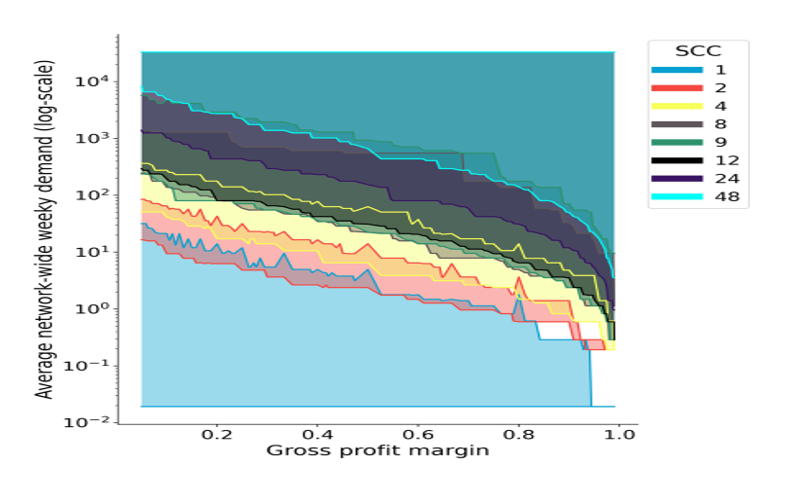
click image to enlarge
ISyE Faculty PI

Benoit Montreuil
Coca-Cola Material Handling & Distribution Chair
Professor
Director of the Physical Internet Center and Executive Director of the Supply Chain & Logistics Institute