
Modeling to Inform Strategies for Guinea Worm Eradication
The Carter Center
Motivation & Problem Description
- The campaign to eradicate Guinea worm disease (GWD) has been a major success, with significant reductions in human infections.
- Animal infections, particularly among domestic dogs, have created challenges, delaying eradication and continuing the risk to the human population. The country of Chad has historically carried the greatest burden of dog infections.
- There is no treatment for Guinea worm disease; current interventions include tethering dogs to prevent contamination of water sources and applying Abate® larvicide to reduce water infectivity.
- The impact of interventions cannot be known for a year or more after implementation due to the long 10 to 14-month pre-patent period of Guinea worm disease.
- As eradication efforts enter the final mile, decision-makers need quantitative tools to understand transmission dynamics and determine how emerging tools can best complement existing interventions.
Objective
- Characterize the transmission dynamics and environmental factors driving observed infection patterns among dogs in Chad.
- Develop a model of Guinea worm transmission among dogs in Chad.
- Evaluate the potential impacts of current and potential interventions for reducing Guinea worm infections among dogs.
- Provide evidence-based recommendations to support operational planning and resource allocation for Guinea worm eradication programs.
Solution
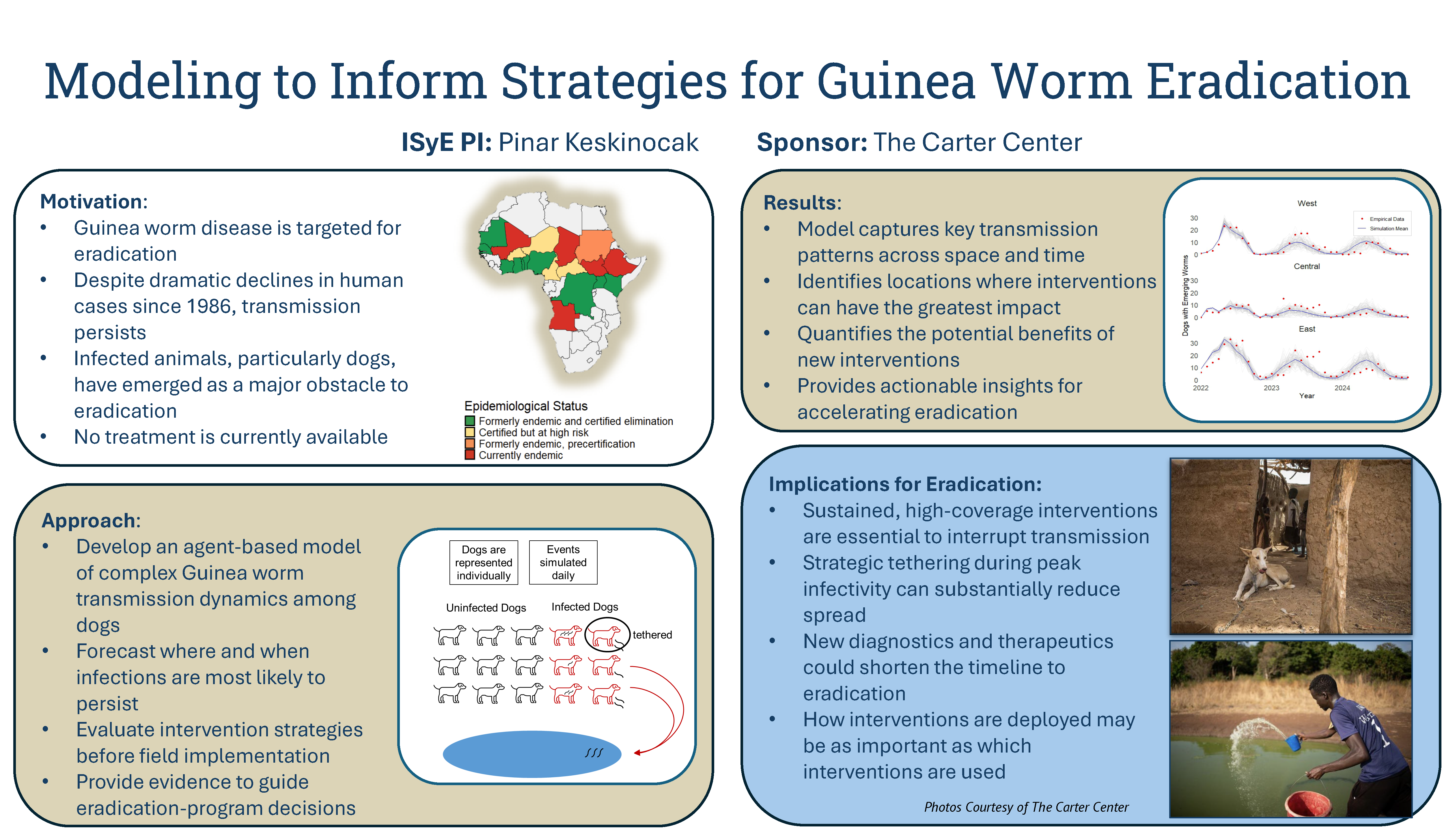
- Developed an agent-based simulation model representing individual dogs, infection progression, water source infectivity, seasonality, environmental conditions, and interventions.
- Evaluated strategies for implementing current interventions, including varied intervention levels and targeting of interventions across endemic regions of Chad.
- Adapted the model to evaluate the potential impact of emerging interventions and tools.
Impact
- Demonstrated that high intervention coverage is required to achieve elimination among dogs in Chad, and quantified the relative impacts of tethering and Abate® under different operational scenarios.
- Provided evidence used to inform development of target product profiles for diagnostic tests and evaluated requirements for successful implementation of these new tools.
- Supported decision-making by the Chad Guinea Worm Eradication Program, The Carter Center, and global eradication partners by providing a quantitative framework for evaluating strategies to accelerate Guinea worm elimination.
click image to enlarge
ISyE Faculty PI

Pinar Keskinocak
H. Milton and Carolyn J. Stewart School Chair
Professor