
Multi-Agent Prediction and Decision Optimization for enhanced Agility and Resilience in Hyperconnected Goal-Oriented Sentient Systems
Cisco Systems, South Shore Furniture
Motivation & Problem Description
- Supply chain networks now operate under constant volatility, where disruptions and artificial demand peaks are permanent features of the landscape rather than rare events.
- Planning for the entire network with one central model is intractable at industrial scale, while decision-making at siloed nodes with disconnected policies leads to either unproductive inventories or lost sales.
- Companies need to sense disruptions early and respond across the whole network, not one facility at a time, and they need to know how ready they are before a disruption hits.
Objective
- Keep demand and supply aligned across a multi-echelon network subject to high volatility and uncertainty.
- Enable collaborative, quasi-autonomous decision-making at every node, from customer order through fulfillment, distribution, production, and supply.
- Give decision-makers a way to measure, diagnose, and improve the readiness of their supply chain against realistic disruption scenarios.
Solution
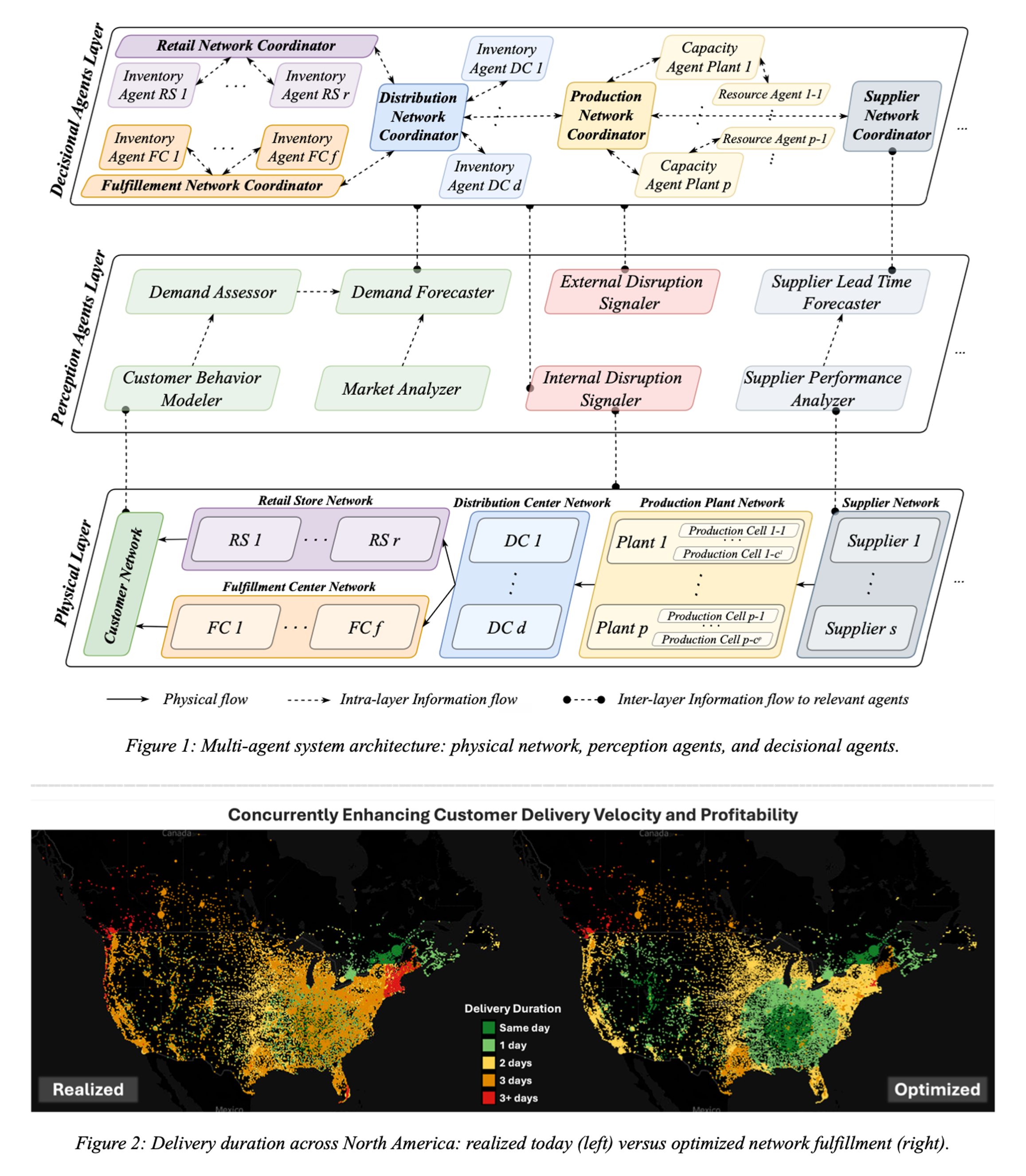
- A multi-agent system architecture supporting the physical network: Each node runs an agent accountable for its own forecasting, inventory, capacity, and coordination decisions, interacting with clients and suppliers through defined protocols.
- Dynamic prediction and early-warning signals: Methods that recover true demand from sales, forecast across product and geographic levels, and raise disruption signals when demand shifts before forecasts can catch up.
- Network-wide decision optimization: Models for fulfillment, replenishment, and production that jointly account for product substitution, lateral transshipment, and flexible sourcing across facilities.
- A simulation testbed: A discrete-event simulator coupled to the agent system, letting a company stress-test its own network against disruption scenarios before committing to any change.
- A readiness framework. A closed loop of risk assessment, readiness assessment, and readiness enhancement that pinpoints the most vulnerable and most critical nodes, processes, and work centers.
Impact
- Higher demand fulfillment and faster recovery after disruptions compared with conventional lean and long-horizon planning.
- Lower inventory per facility while serving more demand, through pooling across locations and products.
- Substantially faster computation, making network-wide daily decision-making practical at industrial scale.
- A readiness metric and vulnerability analysis that pinpoint the most critical nodes, processes, and work centers in a network.
- An educational offshoot: a next-generation supply chain game for multi-echelon network design and management, tested with graduate students at Georgia Tech.
- The largest performance gains appear in broad, dense fulfillment networks that only the top players of e-commerce can afford to own today. The Physical Internet makes that scale reachable for everyone else, by shifting logistics from owned assets to open-access, shareable facilities and services.
click image to enlarge
ISyE Faculty PI

Benoit Montreuil
Coca-Cola Material Handling & Distribution Chair
Professor
Director of the Physical Internet Center and Executive Director of the Supply Chain & Logistics Institute