
Reliable Decison Making in Digital Twins
National Science Foundation, AFOSR
Motivation & Problem Description
- Digital twins continuously exchange information with physical systems. Unlike conventional simulation models, they are updated with streaming data and send predictions and decisions back to the physical system.
- This closed-loop interaction creates a central methodological challenge: decisions must be made and revised while the underlying model is still being learned and updated.
- The project addresses uncertainty from limited physical data, changing model estimates, decision-dependent observations, and constrained simulation and data-collection resources.
Objective
- Develop a unified decision-making perspective for digital twins that connects simulation optimization, stochastic optimal control, reinforcement learning, and risk-aware decision making.
- Determine how a digital twin should combine information across model updates, allocate limited data and simulation resources, and update decisions as new evidence arrives.
Solution
- Model the digital twin as an adaptive data–model–decision loop: physical observations update the twin, the updated model predicts consequences, and a decision module selects actions that affect future states and observations.
- Develop and synthesize methods for data-driven simulation optimization under input uncertainty, streaming data, contextual information, and joint resource allocation.
- Connect digital twins with stochastic control and reinforcement learning, including Bayesian approaches that update models, policies, and risk assessments as information accumulates.
- Use distributionally robust and Bayesian risk formulations to manage model uncertainty and the sim-to-real gap.
Impact
- Provides a common framework for designing digital twins that adapt decisions while learning, rather than treating the twin as a fixed simulation model.
- Clarifies when additional physical data, additional simulation, model updates, or risk protection are most valuable for reliable decisions.
- Supports future digital twins that are adaptive, computationally efficient, risk-aware, and capable of combining automation with human oversight.
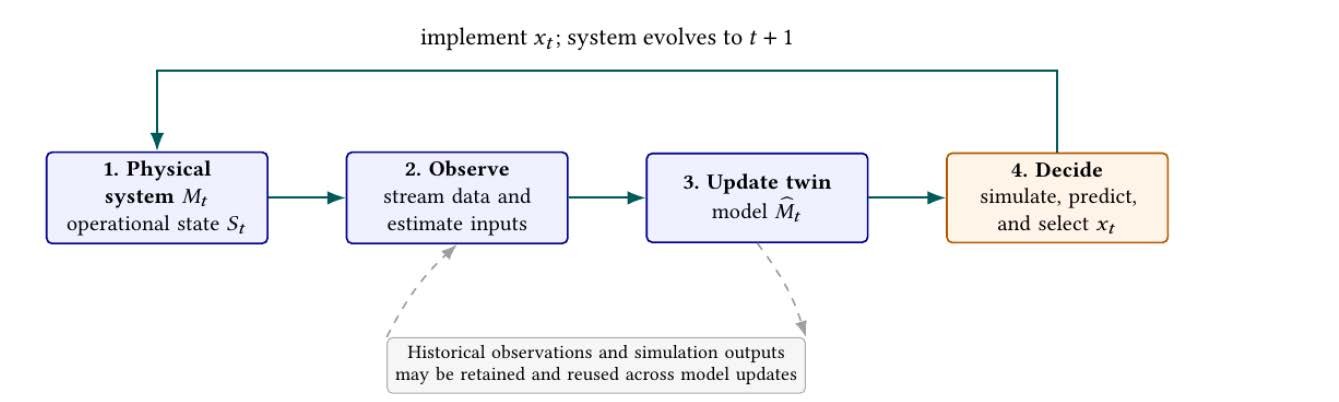
click image to enlarge
changes the physical system and future data.
ISyE Faculty PI
Enlu Zhou
Fouts Family Professor