
Simulation-Based Design and Assessment of Containerized Parcel Network Operations
UPS, Net-Zero Freight Systems Program
Motivation & Problem Description
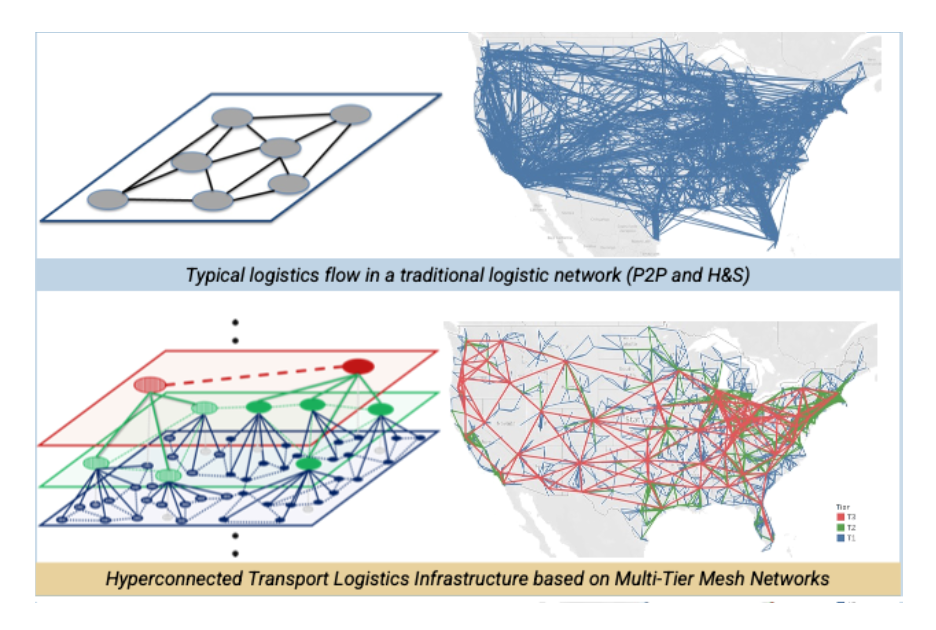
- Parcel delivery networks handle a high volume of individually varying packages differing in weight, volume, shape, and handling requirements. These move through hub-and-spoke and point-to-point networks reliant on heavy, ahead-of-time route and vehicle optimization. This reliance on large-scale, pre-planned integer-programming-based operations often becomes inflexible and computationally heavy, creating frequent ad-hoc plan changes when demand shifts or disruptions occur. Individual-package sorting and handling, rather than consolidated, standardized handling, further limits vehicle capacity utilization and network throughput, while long-haul driver schedules built around these rigid networks contribute to chronically high driver turnover in the trucking industry.
Objective
- To develop and validate a Physical Intranet that transforms traditional parcel networks into hyperconnected, containerized systems, improving transportation efficiency, handling, cost, service, and environmental performance. The project provides a practical roadmap for adopting Physical Internet principles within a single organization; identifying what to implement, in what order, and the expected impact at each stage.
Solution
- The team developed an integrated framework, Hyperconnected Package Transport Logistics Infrastructure (HyPTLI), built on four components: modular containerization, a three-tier mesh hub network, frequency-based (rather than fixed-schedule) transportation, and continuous sorting operations. This framework was operationalized and validated at full continental scale in partnership with UPS, through a large-scale discrete-event simulation built in AnyLogic comparing current single-tier operations against a hyperconnected, three-tier mesh network with modular containerization, frequency-based transportation, and continuous sorting. The simulation modeled UPS's real North American parcel network - approximately 10,000 hubs and 200,000 transportation lanes - processing over 139 million parcels across an 11-day high-demand period. Thirteen scenarios were simulated, incrementally introducing each Physical Intranet component to isolate and quantify its individual and combined impact.
Impact
- The study demonstrates the potential for Physical Intranet principles to simultaneously improve service performance, operational efficiency, cost, and sustainability. The fully integrated Physical Intranet configuration achieved up to 63% reduction in total operational cost and 99.999% on-time delivery, compared to the current-operations baseline. The network also achieved more than 70% reduction in carbon emissions through reduced reliance on air transport in favor of rail and road, and improved driver quality of life, with 86% of drivers able to return home daily versus 79% under current operations.
- Beyond these performance improvements, the project provides a practical implementation roadmap for organizations considering network transformation. Rather than requiring an immediate transition to an open, multi-company Physical Internet, organizations can first implement interoperable logistics principles within their own networks, validate the benefits through large-scale simulation, and progressively build the capabilities required for broader freight collaboration.
click image to enlarge
ISyE Faculty PI

Benoit Montreuil
Coca-Cola Material Handling & Distribution Chair
Professor
Director of the Physical Internet Center and Executive Director of the Supply Chain & Logistics Institute