
Simulation Based Design of Road-Train-Enabled Drayage Services with Hyperconnected Networks
Port City Logistics
Motivation & Problem Description
- Conventional drayage relies heavily on long, one-container movements. A driver and tractor often remain with a single import or export container between the Savannah port and an inland customer, even when many containers travel along the same trunk corridor. This limits opportunities for consolidation and keeps transportation resources committed to long individual trips.
- Imports, exports, and empties are disconnected. An import delivered inland may generate an empty return to Savannah even while a nearby exporter requires equipment. Planning these movements independently creates avoidable repositioning and misses opportunities to connect complementary flows.
- Adopting Physical Internet (PI) principles changes how these movements can be organized. Inland hubs coupled with road-train operations can consolidate trunk flows, connect imports, exports, and empties, and separate long-haul transportation from local customer service. At the same time, this operating model introduces transfers, staging, specialized equipment, and greater coordination requirements. The research therefore asks when and how the gains from consolidation, flow coordination, and resource productivity are sufficient to support the operating structure and infrastructure required by a hub- and road-train-enabled drayage network.
Objective
- Design and evaluate a PI-enabled drayage operating model integrates inland hubs, road-train trunk transportation, local drayage, and coordinated import, export, and empty-container flows.
- Quantify where this operating model creates value relative to conventional direct drayage, considering transportation cost, driver and equipment utilization, empty movements, emissions, and service performance together with the handling, equipment, and hub requirements needed to operate the network.
- Develop a modular multi-agent simulation platform for decision support. Users can configure the network, demand, fleet, operating protocols, and constraints, while agent-based managers plan, dispatch, and execute container movements. The Port City Logistics I-16 corridor serves as the proving ground for the broader approach.
Solution
- Road-train trunk service with local drayage. Road trains consolidate two containers on the high-volume trunk corridor using one driver, while local tractors operate shorter, repeatable customer-service cycles from inland hubs. This replaces selected long, one-container port-to-customer movements with coordinated trunk and local legs.
- Hyperconnected inland-hub relays. Inland hubs connect trunk transportation with local delivery, pickup, and return flows. Containers can change vehicles, wait for downstream movement, or be repositioned without requiring the same tractor and driver to remain attached throughout the journey.
- Connected import, export, and empty-container flows. After an import is delivered, a compatible empty can be supplied to a nearby exporter rather than automatically returning to Savannah. The resulting export can then form a loaded return movement and reduce avoidable empty repositioning and improving equipment productivity.
- A modular multi-agent simulation testbed. Agent-based managers plan and execute loaded, empty-supply, and empty-return movements under common network rules. Scenarios progressively introduce hub transfers, road-train operations, and coordinated flows, allowing their individual and combined effects to be evaluated. The model also represents the specialized chassis, top lifts, staging capacity, and handling requirements needed to operate the proposed system.
Impact
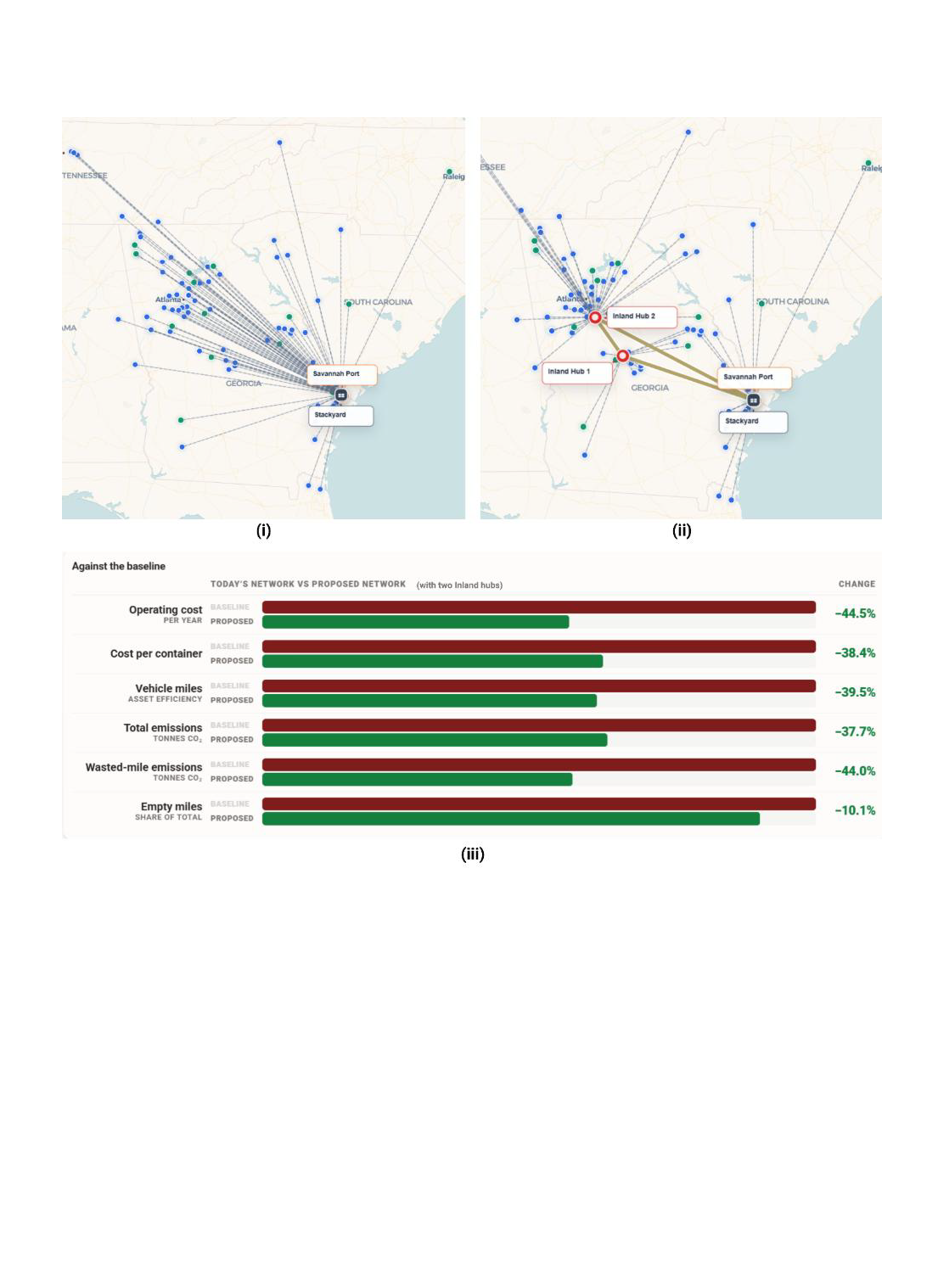
- Substantial improvement in system performance. In the Port City case, the fully integrated inland-hub and road-train configuration achieves approximately 40% lower cost per container and nearly 40% lower wasted emissions than the current-operations baseline while meeting the service promise.
- More productive use of transportation resources. The gains come from fewer empty movements, greater consolidation on trunk corridors, more productive driver and equipment cycles, and opportunities to create loaded road-train returns.
- A clearer understanding of where the operating concept is worthwhile. Road-train chassis, top lifts, hub staging capacity, transfers, and associated dwell all come with operational and capital requirements. The simulation makes these tradeoffs explicit and identifies where the resulting transportation, utilization, and emissions benefits are large enough to support them.
- A practical pathway toward hyperconnected drayage. The I-16 case includes 89 locations—the Port of Savannah, the Port City stackyard, three inland hubs, and 84 customer sites—serving approximately 330,000 containers per year across 80 demand lanes. Port City can first deploy these principles within its own network, validate their value through simulation, and progressively move toward broader sharing of hubs and transportation capacity with compatible freight partners.
- Transferable decision support for other freight corridors. The resulting platform provides a way to evaluate similar PI-enabled drayage concepts across other ports, corridors, logistics providers, and collaborative freight networks.
click image to enlarge
ISyE Faculty PI

Benoit Montreuil
Coca-Cola Material Handling & Distribution Chair
Professor
Director of the Physical Internet Center and Executive Director of the Supply Chain & Logistics Institute