
Toward Hyperconnected Distributed Construction: A Physical Internet Enabled Multi-Tiers Project Driven Hyperconnected Production Ecosystem for Modular Construction
MiTek Inc.
Motivation & Problem Description
- Modular construction has long relied on fixed supply chains and centralized manufacturing facilities, making transportation of completed modules economically unviable.
- This static network structure cannot efficiently serve stochastic demand that varies across time and space, making scalability a barrier between current practice and a nationwide, multi-project implementation.
- Assessing the holistic impact of key decisions at the project level is difficult, as decisions are intertwined with multiple constraints and dispersed among stakeholders.
- Construction experience does not translate into facility-based assembly, while textbook manufacturing doesn’t perfectly match the needs of modular construction, so new methods are needed to efficiently implement modular construction manufacturing.
- MiTek and Georgia Tech are pursuing a multi-year program that builds a hyperconnected distributed construction model and its decision-support system, advancing from computational experiments to field validation.
Objective
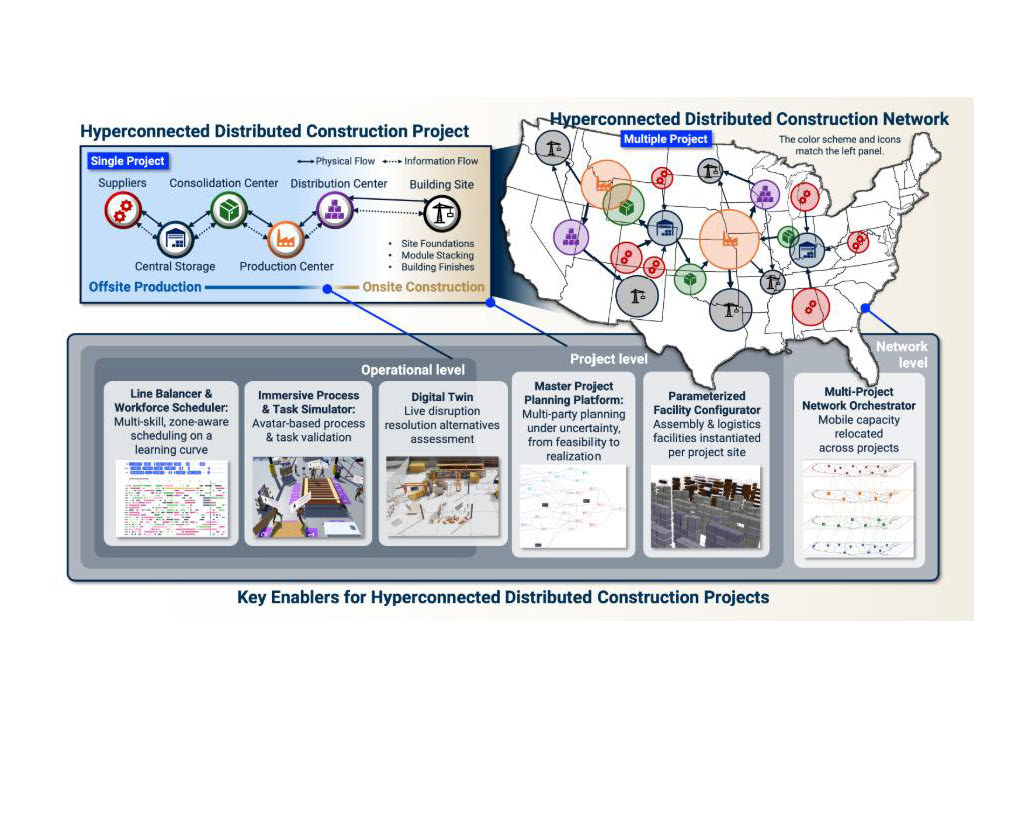
- To develop cutting-edge solutions in supply chain, logistics, manufacturing, and project design and planning to enable the scalable implementation of Hyperconnected Distributed Construction (HDC), a model and ecosystem-wide platform to be implemented by our partner MiTek. In this model, modular assembly and logistics capabilities are deployed where and when projects call for it, and the system can be reconfigured as demand shifts, accounting for multiple stakeholders jointly planning and operating an open interconnected network.
Solution
- The following solutions enable hyperconnected distributed construction, spanning from the network to the operational level, facilitated with various technical concepts.
- Master Project Planning Platform for Hyperconnected Distributed Construction: Supports planning from early feasibility through realization. Key actors set the high-level design decisions, and the platform engineers the finer ones beneath them, validating joint feasibility under dynamic multi-stakeholder conditions. It rests on fast heuristics, global optimization, and an embedded AI agent.
- Digital Twin for Project-Level and Assembly-Operations: For supporting operational efficiency under disruptions, a discrete-event agent-based digital twin was designed and implemented, capable of initializing from any operational state receiving information live from the real system. These models allow forecasting the behavior of the system under various disruption management strategies, enabling fast and effective decision-making towards minimizing the impact of disruptive events.
- Multi-project & Multi-party Network Orchestrator: Multi-tier mobile supply chains that add a mobile consolidation layer upstream of mobile production capacity, with both tiers deployable and repositionable across the network as demand shifts in space and time. The approach moves from tailored demand forecasting and deterministic network design to simulation-optimization under multiple sources of uncertainty.
- Parameterized Process & Facility Designer: Instantiates a generic, parameterized design of the production process, facilities, and staging sites, including their inventory and storage requirements, for a specific project and site. Exact and heuristic optimization combined with takt time and fractal concepts keeps the framework reconfigurable enough to instantiate anywhere while still yielding a high-performance layout.
- Avatar-Based Immersive Process and Task Emulator: Represents and animates assembly operations at the granularity of individual worker motions, a level at which aggregated planning models cannot see how coordination and physical burden shape performance. Decision-makers can test alternative crew configurations and action sequences, exposing efficiency and safety implications before they reach the floor.
- Multi-Skill, Zone-Aware Line Balancer and Workforce Scheduler: Balances assembly lines and schedules multi-skilled crews across kitting, module assembly, and material handling, where parallelism is limited by zone interference and task times improve over the project. Dynamic work assignment exploiting multi-skill crews and zone-based concurrency feeds a master operations planner accounting for stochasticity and disruptions.
Impact
- Scalability Beyond the Fixed Facility: Assembly and logistics capacity is deployed where demand arises and redeployed as it shifts, opening the path from single-project delivery to nationwide, multi-project operation.
- Downstream Visibility Across System-Wide Decisions: Stakeholders can see how a choice propagates through the rest of the system before it is locked in, supported by optimization and simulation, immersive 3D/4D environments, and AI-agent capabilities.
- Operational Resilience Under Uncertainty: Digital twins and the underlying planning and scheduling algorithms allow disruptions and candidate resolutions to be evaluated and re-planned before execution on the plant floor, turning disruption response from reactive firefighting into a proactive operational capability.
- From Academic Research to Commercial Practice: Developed through action research over successive phases, the models, algorithms, and platform have advanced from research prototypes to deployment in commercial projects.
click image to enlarge
ISyE Faculty PI

Benoit Montreuil
Coca-Cola Material Handling & Distribution Chair
Professor
Director of the Physical Internet Center and Executive Director of the Supply Chain & Logistics Institute